
growing graduate studies
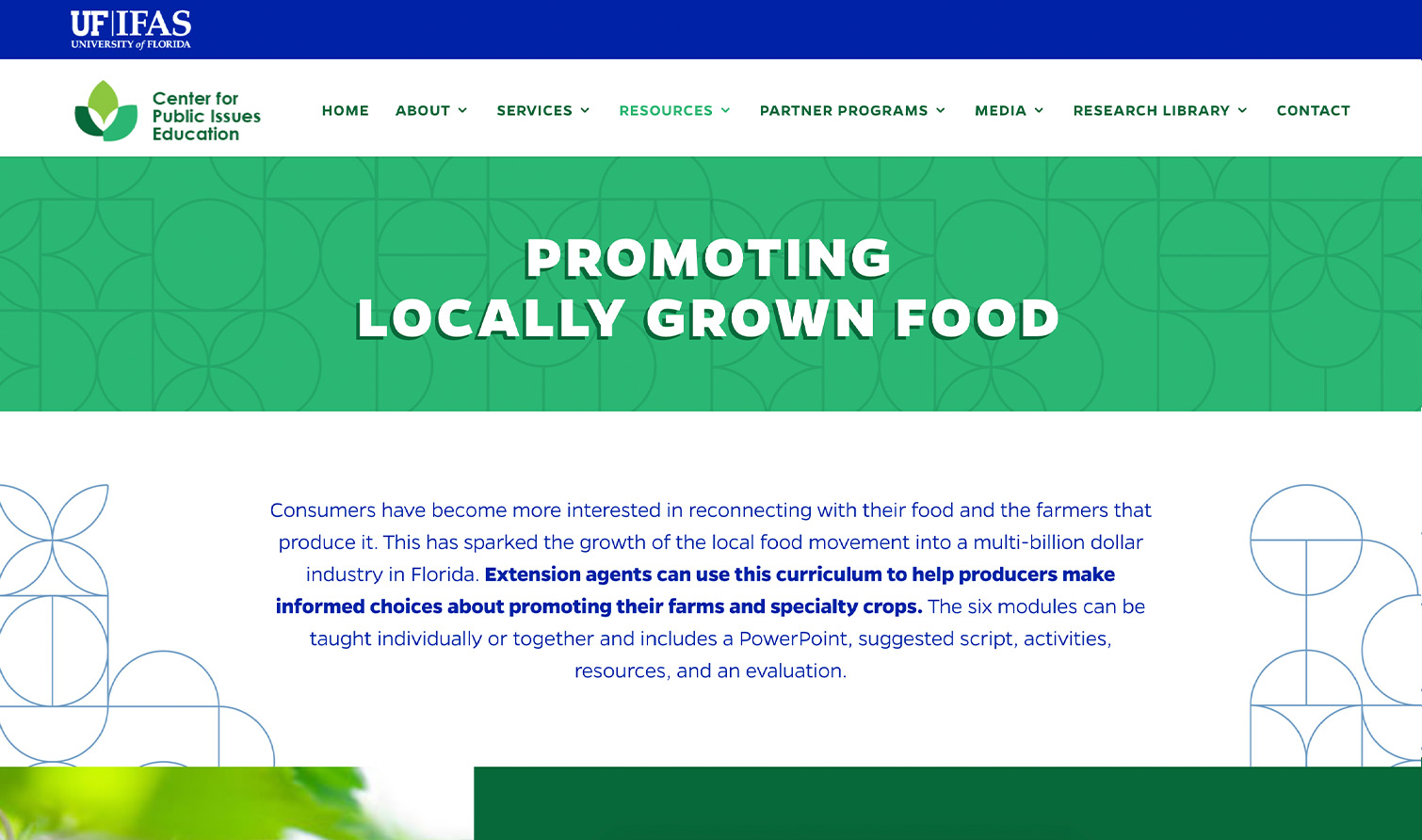
This project is a collaboration between the UF/IFAS Center for Public Issues Education, and the University of Minnesota. Project participants include Rebecca Swenson, Lauri Baker, Sadie Hundemer, Troy McCay, Ashley McLeod-Morin, Hikaru Peterson, and Garrett Steede.
Learn more about this project below!

This project aims to develop an online science communication curriculum tailored for graduate students in FANH (Food, Agriculture, Natural Resources, and Human Sciences) disciplines. The primary outcomes will be modular resources designed to enhance students’ understanding of science communication theory, ethical practices, critical thinking, decision-making skills, and the ability to create content for diverse audiences. Partnering institutions will create these modules in an online format, complete with lesson plans and materials. The modules will be made available for faculty at any FANH institution to use, and their effectiveness will be assessed by participating faculty. The goal is to improve the quality of science communication instruction, especially in FANH disciplines where faculty expertise in communication may be limited. Ultimately, the project aims to broaden access to scientific knowledge, better equip future scientists in communicating with diverse audiences, and positively impact the public perception of FANH sciences. Explore our modules below.
This work was supported by a Higher Education Challenge grant (award number 2023-70003-3877), from the U.S. Department of Agriculture, National Institute of Food and Agriculture.
Student learning outcomes
The Growing Graduate Studies Project can be organized by Student Learning Outcomes (SLOs) and allows you to download complete sets of modules grouped by each designated outcome. This option is best suited for those seeking a coordinated set of modules that help meet a defined student learning outcome. The section below provides access to individual modules, which can be downloaded independently. This option is useful for users who are seeking a specific topic or resource without needing the full set associated with a particular learning outcome.
individual modules
1. Introduction to Science Communication
This module introduces the idea of science communication and some key ideas when recognizing and defining science communication practices. Content covers defining science communication, understanding what it includes, the importance of science communication, approaches to sharing science with the public, the role of scientists in public and private entities, and foundational concepts related to storytelling in science. Students can apply these ideas by analyzing and creating elevator speeches, comparing cases in science communication, and drafting short research pitches for technical and nontechnical audiences. Module content covers roughly 3-6 class sessions. It is broken down into three parts:
- Introducing Science Communication
- Approaches to Science Communication
- Storytelling in Science
Download Module 1 ↓
2. Communication Theory
The purpose of this module is to provide students with an introductory understanding of conceptual and theoretical frameworks relevant to science communication. The module begins with a basic introductory lesson that covers how theoretical and conceptual frameworks are used in communication research. Students will learn how to:
- Critique theories according to their appropriate criteria
- Understand, explain and use theoretical and conceptual frameworks to guide and inform scholarship in science communication
- Develop your critical thinking and analysis skills
Download Module 2 ↓
3. Concepts of Strategic Science Communication
The purpose of this module is to help students leverage key principles about strategic communication planning when conducting science communication work. The module introduces how to approach strategic planning for science communication and guides students in the creation of plans that can guide strategic communication efforts. After completing this module, students will be able to:
- Recognize and define the major components of strategic communication planning.
- Apply foundational strategic communication planning principles to science communication topics, approaches, and issues.
Download Module 3 ↓
4. Issue Based Communication
The purpose of this module is to provide students with an introductory understanding of communication approaches to issues in agriculture and natural resources. After completing this module, students will be able to:
- Prepare communication responses to crises.
- Construct solutions-based communication.
- Engage stakeholders in decision-making.
- Assess and construct strategies for value-based conflict.
- Develop critical thinking and analysis skills.
Download Module 4 ↓
5. Ethics in Science Communication
The purpose of this module is to provide students with an introductory understanding of ethical practices in science communication. The module introduces the importance of and issues related to ethics in science communication. After completing this module, students will be able to:
- Define ethics as it relates to science communication
- Apply ethical principles to science communication issues
Download Module 5 ↓
6. Research in Science Communication
The purpose of this module is to provide students with an introductory understanding of research within science communication. The module includes an introduction to methodologies and approaches to science communication research and concludes with an overview of the importance of problem statements and equips students with the knowledge to develop a problem statement for a science communication issue/topic. After completing this module, students will be able to:
- Understand approaches to social science research
- Evaluate research literature
- Develop a problem statement
Download Module 6 ↓
7. Research Methods in Science Communication
The purpose of this module is to provide students with an introductory understanding of the research methods most commonly used in science communication. After completing this module, students will be able to:
- Describe each of the core methods used in science communication research.
- Select methods that align with their research purpose.
- Develop basic research strategies using a variety of methods.
- Develop critical thinking and analysis skills
Download Module 7 ↓
8. Audience Analysis
The purpose of this assignment is to apply the skills learned in the audience analysis lesson to develop a plan for needs analysis and content tailored to a specific audience. After completing this assignment, students will be able to:
- Identify their audience.
- Use effective methods for audience needs analysis.
- Present detailed information about target audience.
- Create content tailored to target audience.
Download Module 8 ↓
9. Communication Evaluation
This module introduces ideas on how to establish and monitor success metrics that can guide the evaluation of science communication efforts. Content establishing metrics and aligning these with communication goals, applying models to measurement and evaluation work, and advanced tools that may support communication evaluation work. Students can apply these ideas to their own short and long-term communication efforts. Here is an overview of module content:
- Overview of different types of evaluation
- Motivations for and barriers to effective evaluation
- Key principles and best practices for conducting effective measurement and evaluation
- Establishing metrics
- Models and tools to guide evaluation
Download Module 9 ↓
10. Data Analysis
The purpose of this module is to provide students with an introductory understanding of Excel for social science data analysis and how to accurately perform basic statistical analysis. After completing this module, students will be able to:
- Import social science data in Excel Clean and prepare data for analysis
- Perform basic statistical analysis in Excel
- Describe basic statistical methods and this means for data interpretation
- Design charts and tables in Excel
- Use appropriate tools to create visuals for data interpretation
- Adopt best practices for social science data analysis
Download Module 10 ↓
11. Data Visualization
The purpose of this module is to provide students with an introductory understanding of data visualization and how to effectively tell a story with data with the purpose of communicating research. After completing this module, students will be able to:
- Describe what data visualization can do in presenting data.
- Choose the right visual that will tell the story of their data.
- Think Big, and Think Visually
- Select appropriate social media channels for their audience.
Describe what makes the best visuals on social.
Download Module 11 ↓
12. New Media
The purpose of this module is to provide students with an introductory understanding of new (social) media and how to effectively create an online presence with the purpose of communicating science. After completing this module, students will be able to:
- Describe what science communication on social media can do
- Use effective strategies for communicating science online
- Select appropriate social media channels for their audience
- Develop a social media plan
- Calculate return on investment (ROI) for social media
Download Module 12 ↓
13. Written Communication
The purpose of this module is to provide students with an introductory nderstanding of the forms of written communication often used by science writers. Specifically, the module covers three formats: hard news articles, press releases, and feature articles. After completing this module, students will be able to:
- Describe the differences between hard news and feature writing.
- Develop a hard news article, press release, and feature article.
- Properly format a press release.
- Develop critical thinking and analysis
Download Module 13 ↓
14. Oral Communication
This module introduces the foundational speech-writing and speaking skills needed to communicate science effectively. Content covers structuring informative and persuasive content, using different types of evidence to back-up claims, constructing engaging slides, and tips for delivering confident and clear messages. Students can apply these ideas by analyzing presentations and then developing two short speeches of their own: an informative speech (see chalk talk assignment) and a persuasive speech (see lightning talk assignment) on the same scientific topic. Module content covers approximately 4 class sessions. It is broken down into three main sections:
- Foundational principles for oral communication
- Tips for informative and persuasive speeches
- Tips for delivery
Download Module 14 ↓
15. Media Skills
Media relations skills are essential for science communicators to effectively engage with the public, bridge the gap between science and society, and promote informed decision-making. By developing these skills, we can enhance the visibility, credibility, and accessibility of scientific information, and foster meaningful dialogue with the public. After completing this module, students:
- Understand the basic concepts of media relations and the responsibilities of a communicator
- Understand how to speak concisely in sound bites for the media
- Be able to develop media contacts as a science communicator
Download Module 15 ↓
16. Visual Design and Photography
The primary purpose of this module is to empower students with the skills to craft visually engaging and informative infographics. By exploring design principles, information synthesis, and data visualization, students will gain proficiency in creating impactful visual narratives for a broad audience.
Skills Practiced:
- Information Synthesis and Simplification:
- Students will practice synthesizing complex scientific information into key messages suitable for infographic presentation.
- Develop the ability to simplify and clarify complex data for better audience understanding.
- Visual Communication and Design Principles:
- Master the use of design principles such as hierarchy, color, typography, and layout to create visually appealing infographics.
- Practice conveying scientific concepts through effective visual elements.
- Data Visualization Techniques:
- Gain proficiency in visualizing data to enhance the overall clarity and impact of the infographic.
Download Module 16 ↓
17. Audio Storytelling
This module is designed to provide learners with a foundational understanding of basic audio production concepts, including how to develop and create a podcast series, introduce essential podcasting equipment, and explore basic audio production concepts terminology and techniques. By the end of this module, participants will have a solid grasp of the technical and logistical aspect of creating audio productions. By the end of this module, students will be able to:
- Identify their podcast audience and articulate their purpose.
- Plan and structure podcast episodes effectively.
- Utilize sound principles to enhance storytelling.
- Select appropriate gear and software for recording and editing.
- Create a cohesive podcast format with effective intros and outros.
Download Module 17 ↓
18. Videography
This 4-module lesson plan is designed for college professors who are unfamiliar with video production but wish to introduce students to the basics of creating a short science documentary film. Each module is independent but interconnected, employing a scaffolding approach to build students’ skills progressively. This flexible plan allows instructors to tailor the content and teaching methods to fit their unique classroom dynamics.
- Introduction to Video Production Basics and the Production Cycle
- Developing a Story and Script
- Filming and Production Techniques
- Post-Production and Finalization
Download Module 18 ↓