
Introduction
The Florida Sod Growers Cooperation (FSGC) enlisted the PIE Center to conduct a survey of horticulture Extension agents, master garden coordinators and master gardeners, seeking to measure the perceptions of turf grass. Together, the PIE Center and FSGC crafted a web-based questionnaire that was sent to a sample of 100 horticulture Extension agents, who were asked to forward the survey to master gardeners and coordinators. More than 260 people responded and 71% of those repondents classified themselves as master gardeners.
Key findings
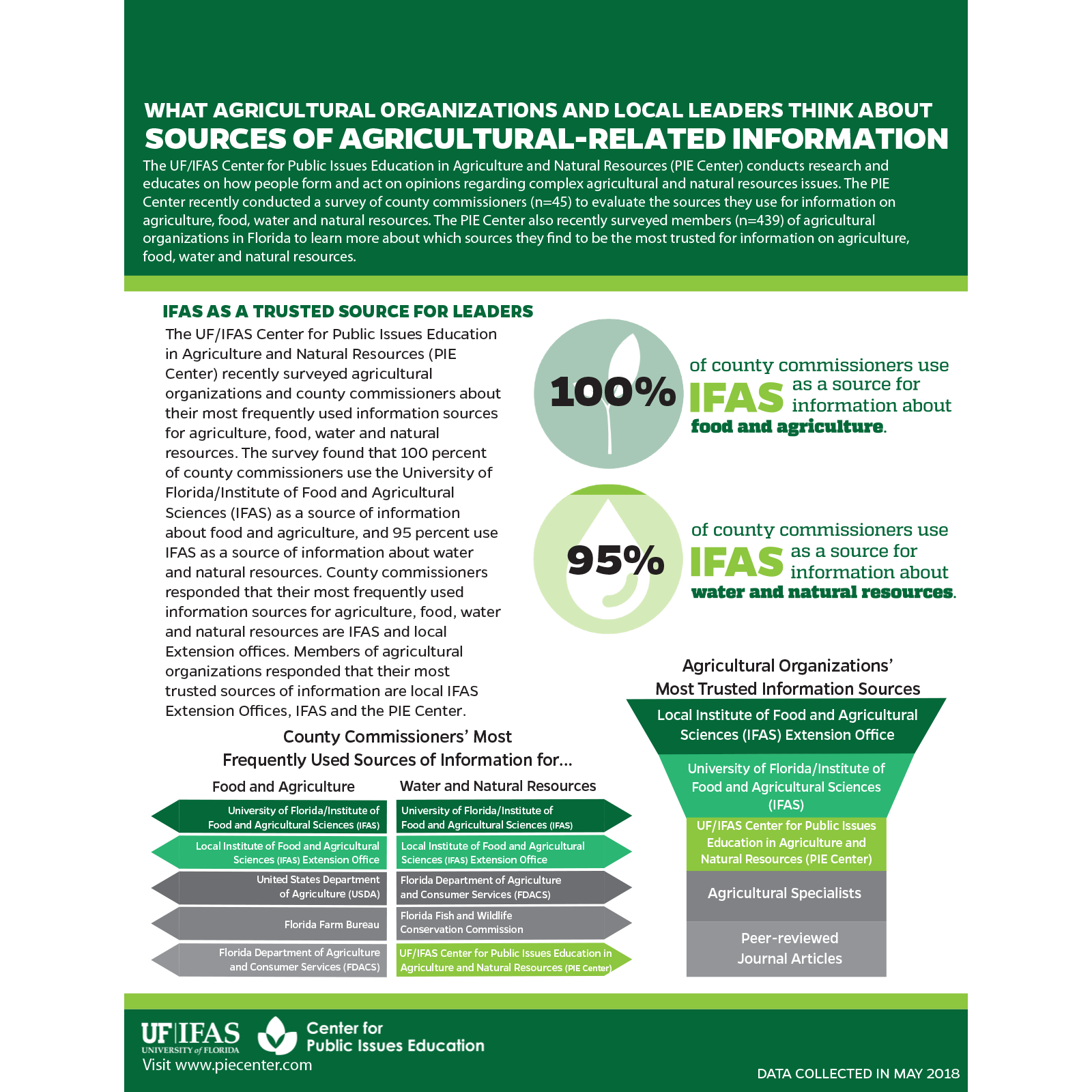
Respondents’ most reliable source of information regarding turf grass and lawn care was the UF/IFAS or other university websites, with 93% saying they were likely or very likely to visit the sites.
When asked about their general perceptions, 76% of respondents agreed or strongly agreed that turf grass was “neither good nor bad it all depends on how you maintain it.” The same percentage agreed or strongly agreed that turf grass has many benefits if it’s cared for responsibly. As far as participants’ concerns, 87% identified the amount of water used and 77% singled out the amount of fertilizer used.
However, the majority of respondents thought that turf grass fit within a Florida-Friendly Landscape. Further, 35% of respondents identified “how to have a lawn, but still be Florida Friendly” as the biggest educational need. When asked what the turf grass industry should do to help provide education, respondents overwhelmingly stated that public awareness and more realistic expectations of turf were needed. Qualitative responses encouraged the industry to utilize Extension to help the sod industry reach its educational goals.
Recommendations
The PIE Center highly recommended FSGC participate in a communication audit to help determine how to adjust current communication tools and methods to specifically gear Extension messaging for outreach and education purposes. During a communication audit, the PIE Center would examine a representative sample of materials used by FSGC to communicate with external and internal audiences.
Based on the results, the development of integrated awareness and public relations campaigns could help establish partnerships with local home improvement and garden stores as well as develop education and communication tools for Extension.
In addition, the PIE Center urged collaborations with other similar state associations to form a focused plan for outreach, education and general public relations. Uniform communication across all similar associations would increase the strength of the messages and reduce the ambiguity or redundancy among the different associations. Finally, the associations should publish one website branded for outreach and education. The credibility of the education site would be boosted from the support of the multiple associations.